

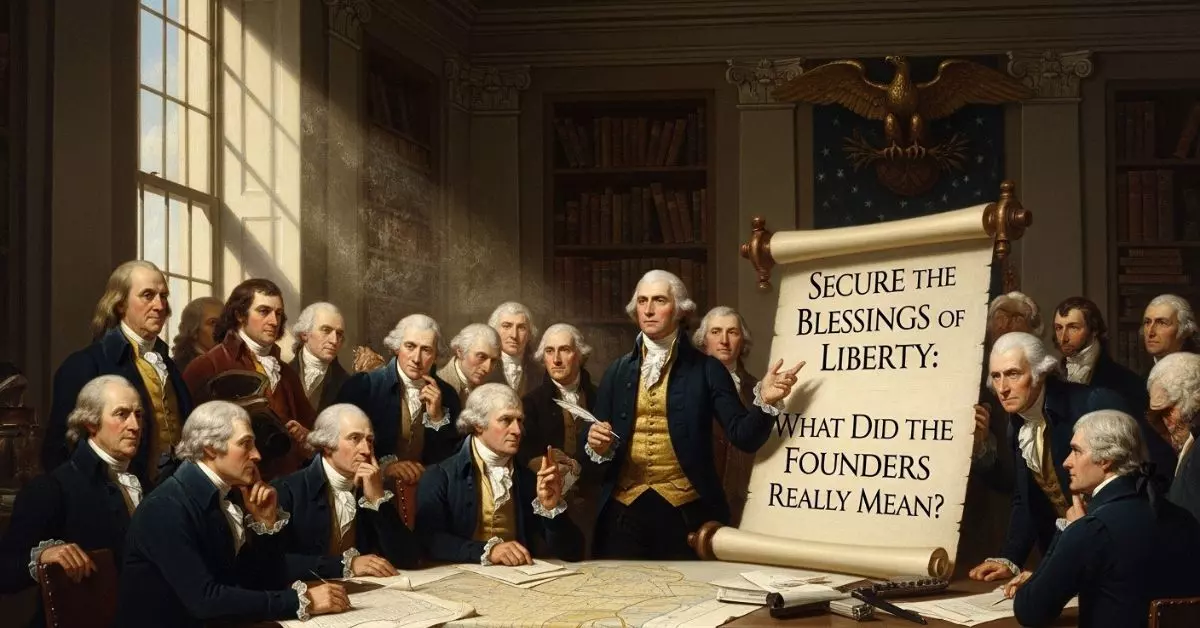
The phrase “Secure the Blessings of Liberty” sits at the very heart of the United States Constitution’s Preamble and represents one of the most powerful commitments ever made by a government to its people. The Founding Fathers chose these words deliberately to express their belief that freedom was a natural right belonging to every human being, and that the government’s highest duty was to protect individual liberty and constitutional rights.
Having suffered under the oppressive rule of the British Crown, they were deeply determined to build a nation where tyranny could never take hold and where every citizen could live, speak, and think freely. This phrase was not just a statement of intention but a solemn promise to both present and future generations that America would always stand as a guardian of human liberty and democratic freedom.
What Does “Secure the Blessings of Liberty” Mean?
“Secure the Blessings of Liberty” is one of the most powerful phrases in the United States Constitution’s Preamble. It refers to the government’s fundamental duty to protect and preserve the natural freedoms and civil liberties that belong to every citizen.
The word “secure” implies an active, ongoing responsibility — not merely granting liberty, but defending it from threats both foreign and domestic. The Founders believed that liberty was not something the government gave to the people, but rather something the government was created to guard on the people’s behalf.
Understanding the Preamble and Its Purpose
The Preamble to the United States Constitution serves as an introductory statement that outlines the core goals and intentions behind the entire document. It does not grant rights or establish laws on its own, but instead explains why the Constitution was written and what it was meant to achieve.
The Preamble lists six key objectives: forming a more perfect union, establishing justice, ensuring domestic tranquility, providing for the common defense, promoting the general welfare, and securing the blessings of liberty to ourselves and our posterity. Together, these goals paint a picture of the kind of nation the Founders envisioned — one built on fairness, peace, and protected freedom for all Americans.
The Meaning of “Blessings of Liberty”
The phrase “Blessings of Liberty” reflects the Founders’ belief that freedom is not just a political right, but a profound and almost sacred gift rooted in Enlightenment philosophy and natural law. By calling liberty a “blessing,” they elevated it beyond a simple legal concept and acknowledged it as something deeply valuable to human life and dignity.
These blessings include the freedom to speak, worship, assemble, and pursue one’s own path without undue interference from the government. The Founders understood that a society where individuals could live freely and authentically was a society that would thrive, innovate, and flourish over time.
To Ourselves and Our Posterity: What It Really Means
The Preamble’s phrase “to ourselves and our posterity” makes clear that the Constitution was written not just for the people alive in 1787, but for every generation of Americans that would follow. “Posterity” refers to future descendants — children, grandchildren, and all who would come after, carrying forward the legacy of constitutional democracy.
This forward-looking language shows that the Founders were thinking beyond their own time, hoping to create a lasting framework of liberty that would endure for centuries. It placed a moral obligation on each generation to preserve and pass on the freedoms they inherited, ensuring the promise of civil rights and liberty would never be lost.
What Does Liberty Mean in the Preamble?
In the context of the Preamble, liberty refers to the condition in which individuals are free from oppressive restrictions imposed by authority, whether that authority is a king, a government, or any other powerful force. It encompasses both personal freedom — such as the right to live, speak, and believe as one chooses — and political freedom, including the right to participate in one’s own governance and democratic process.
The Founders were deeply influenced by Enlightenment thinkers like John Locke, who argued that liberty was a natural right that no government could legitimately take away. For them, liberty was the very foundation upon which a just and democratic society had to be built.
The Founders’ Vision: Securing Freedom for All
The Founders envisioned a nation where the government existed not to dominate its citizens, but to serve and protect them through limited government and equal rights. Having lived under what they considered the tyrannical rule of the British Crown, they were determined to create a system of government that would prevent the abuse of power and safeguard individual freedom.
They designed the Constitution with checks and balances, separation of powers, and protected rights to ensure no single person or group could seize control and strip people of their liberty. Their vision, though imperfect in its original application, was ultimately one of a free society where all people could live with dignity and self-determination.
The Connection Between Liberty and Justice
Liberty and justice are deeply intertwined concepts in the American constitutional framework, as each depends on the other to function properly. Without justice, liberty becomes a privilege enjoyed only by the powerful, while the weak and marginalized are left without protection or equal rights under the law.
Without liberty, justice becomes an empty concept, enforced by a government that controls rather than serves its people. The Founders recognized this relationship and deliberately linked the two in the Preamble, understanding that a truly free society must also be a fair one — where the law applies equally to all and where freedom is not used as a weapon against others.
Why “Secure the Blessings of Liberty” Still Matters Today
The phrase “Secure the Blessings of Liberty” remains as relevant today as it was when it was first written over two centuries ago, because the work of protecting freedom and civil liberties is never truly finished. In every generation, new challenges arise that test the boundaries of constitutional rights — from debates over free speech and digital privacy to questions of racial equality and justice for all Americans.
The phrase serves as a constant reminder that the government’s highest duty is to its people’s freedom, and that citizens must remain engaged and vigilant to hold their leaders accountable. As long as liberty is something that can be threatened, it is something that must be actively and passionately defended.
How the Government Works to Secure the Blessings of Liberty
Upholding the Constitution: The government enforces constitutional laws that protect the fundamental rights and freedoms of every American citizen.
Maintaining an Independent Judiciary: Courts and judges serve as neutral bodies that ensure laws are applied fairly and that no one’s liberty is unlawfully taken away.
Providing National Defense: The military and security agencies protect the nation from foreign threats that could endanger the freedom and safety of its people.
Enforcing Civil Rights Laws: The government passes and enforces legislation that prevents discrimination and ensures equal liberty for all people regardless of race, gender, or religion.
Balancing Power Through Checks and Balances: The three branches of government — legislative, executive, and judicial — monitor each other to prevent any single branch from abusing its power over citizens.
Examples of Securing the Blessings of Liberty in Everyday Life
Freedom of Speech: Citizens can openly express their opinions, criticize the government, and engage in public debate without fear of punishment or censorship.
Right to a Fair Trial: Every person accused of a crime is entitled to a fair and speedy trial, ensuring that justice is served and liberty is not wrongfully stripped away.
Freedom of Religion: Americans are free to practice any religion they choose, or no religion at all, without government interference or persecution.
Access to Public Education: Free public education gives every child the knowledge and skills needed to grow into an informed, independent, and capable citizen.
Right to Vote: The ability to participate in elections allows citizens to directly shape their government and ensure their voices and freedoms are represented.
The Responsibility of Citizens in Preserving Liberty
Staying Informed: Citizens must educate themselves about current events, government actions, and laws so they can make responsible decisions and hold leaders accountable.
Participating in Elections: Voting is one of the most powerful tools citizens have to protect democracy and ensure that leaders who value liberty are placed in power.
Respecting the Rights of Others: True liberty requires that every individual honors the freedoms of others, understanding that one person’s rights end where another’s begin.
Speaking Out Against Injustice: When liberty is threatened or rights are violated, citizens have a duty to peacefully protest, speak up, and demand that justice be restored.
Engaging in Community Service: Active involvement in local communities strengthens the social fabric of society and helps preserve the shared values of freedom and democracy.
Featured Local Savings
Featured local savings are one of the most practical ways that everyday Americans can stretch their hard-earned dollars while still supporting the businesses in their own communities. From grocery store discounts and restaurant deals to coupons at local shops and family-owned businesses, these savings opportunities are designed to help people spend less without sacrificing quality.
Many local governments, community organizations, and small businesses offer special discount programs and seasonal promotions that are specifically tailored to the needs of residents in a particular area. Taking advantage of featured local savings not only puts more money back in the pockets of working families but also strengthens the local economy by keeping spending within the community.
Is America Still the Land of the Free?
The question of whether America is still the land of the free is one that sparks passionate debate across the country, touching on issues of civil rights, government power, and social justice. Since its founding, America has been celebrated as a nation built on the ideals of liberty and opportunity, drawing millions of people from around the world who came seeking a better and freer life with equal rights and constitutional protections.
However, many Americans today argue that true freedom remains out of reach for large portions of the population, pointing to systemic inequalities, racial injustice, and economic hardship as evidence that the promise of freedom has not been fully kept. While the United States still guarantees more legal protections and democratic freedoms than many countries in the world, the ongoing struggle to make those freedoms equally accessible to every citizen remains one of the most important and unfinished challenges in American history.
Frequently Asked Questions
What does “Secure the Blessings of Liberty” mean?
It means the government has a duty to actively protect and preserve the natural freedoms and civil liberties of every citizen.
Where does the phrase “Secure the Blessings of Liberty” appear?
It appears in the Preamble to the United States Constitution, written in 1787.
Who wrote the phrase “Secure the Blessings of Liberty”?
It was written by the Founding Fathers, with James Madison playing a major role in drafting the Constitution.
Why did the Founders use the word “secure” instead of “give”?
Because they believed liberty was a natural right that already belonged to the people, not something the government could give.
What does the word “blessings” mean in this phrase?
It means that liberty is a precious and sacred gift that deserves the highest level of care and protection.
Who are “ourselves and our posterity” in the Preamble?
They refer to the people alive in 1787 and all future generations of Americans who would inherit the Constitution and its constitutional rights.
What type of liberty were the Founders referring to?
They referred to both personal freedom, such as speech and religion, and political freedom, such as the right to vote and self-govern in a democratic society.
Conclusion
The phrase “Secure the Blessings of Liberty” remains one of the most enduring and meaningful commitments in the history of democratic governance, reminding every generation of Americans of their responsibility to protect freedom and uphold constitutional rights. The Founders wrote these words not just for themselves but for every person who would ever call America home, creating a legacy of liberty and equal rights that has guided the nation through its greatest challenges.
While the original Constitution was imperfect in its protection of all people, the spirit of this phrase has inspired countless movements, amendments, and reforms that have worked to expand freedom and justice for all. Today, securing the blessings of liberty is still an active and ongoing responsibility that belongs not just to the government but to every informed and engaged citizen who believes in the promise of a truly free nation.

Laiba SEO is a digital marketing specialist focused on search engine optimization, celebrity news trends, and content strategy. She helps brands grow online visibility through data-driven SEO and engaging content.