

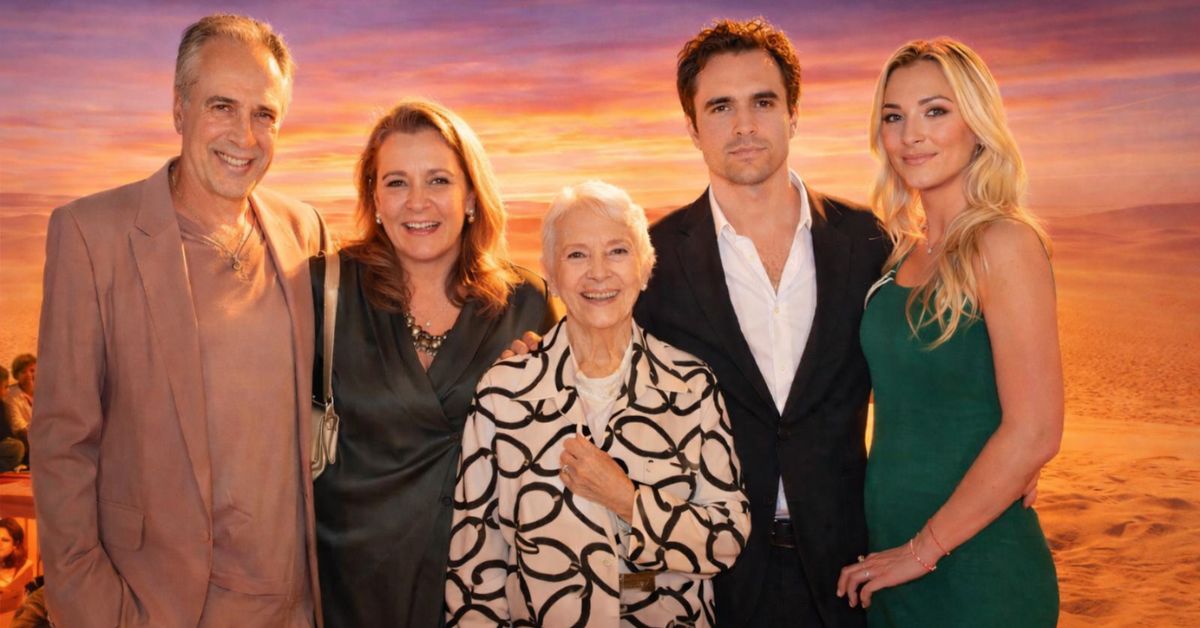
Deborah Mackin is more than just the mother of Hollywood star Florence Pugh. She is a strong, graceful woman whose life story stays mostly away from the spotlight, yet quietly shapes one of today’s most talented actresses. While Florence shines on red carpets and movie screens, Deborah has remained a steady force behind the scenes—offering guidance, emotional strength, and family values that helped build Florence’s confidence and independence from a young age.
Despite public curiosity, Deborah Mackin has chosen a private and grounded life, making her story even more intriguing. From her personal background to her influence on Florence Pugh’s career choices, there are many lesser-known facts that fans rarely hear about. This article uncovers Deborah Mackin’s untold journey, her role as a supportive mother, and the quiet impact she has had on Florence’s rise to global fame—without chasing attention or recognition.
Who Is Deborah Mackin?
Deborah Mackin is best known as the mother of award-winning actress Florence Pugh, but her identity extends far beyond that familial connection. Born around 1964 in England, Deborah is a former professional dancer and dance teacher who trained at prestigious institutions including the Laban Centre in London and Tring Park School for the Performing Arts. Her background in the demanding world of contemporary dance and performance gave her unique insights into the creative process, discipline, and what it takes to succeed in the arts—knowledge she would later pass on to her children with remarkable results.
As a supportive mother of four children—Arabella, Toby Sebastian, Florence, and Rafaela—Deborah created a creative household where artistic expression flourished without pressure. Together with her partner Clinton Pugh, a restaurateur and designer, she raised her family in Oxfordshire, England, fostering an environment that valued creativity, hard work, and authenticity. Her parenting philosophy blended high standards with unconditional support, teaching her children that professionalism and joy are not mutually exclusive.
Quick Bio of Deborah Mackin
| Attribute | Details |
| Full Name | Deborah Mackin |
| Birth Year | 1964 |
| Age | Around 60 years |
| Nationality | British |
| Profession | Professional Dancer, Dance Teacher, Creative Personality |
| Education | Laban Centre, London (Contemporary Dance) |
| Spouse | Clinton Pugh |
| Children | Florence Pugh, Toby Sebastian, Rafaela Pugh, Arabella Gibbins |
| Notable Fact | Mother of award-winning actress Florence Pugh |
| Famous Anecdote | Spent time with Snoop Dogg at the 2020 Oscars after-party |
| Hobbies / Interests | Dance, teaching, herbal sprays, natural potions |
| Personality Traits | Creative, disciplined, energetic, free-spirited |
| Public Recognition | Known through her children, especially Florence Pugh |
Early Life and Dance Background
Born around 1964 in England, Deborah Mackin grew up during a vibrant era for the performing arts in Britain. From an early age, she demonstrated a natural passion for movement and creative expression, drawn to the world of dance and performance. Unlike many who viewed the arts as merely a hobby, Deborah saw it as her calling, dedicating herself to pursuing dance professionally. Her early years were marked by a determination to transform her artistic interests into a serious career, a commitment that would require years of rigorous dance training and discipline.
This foundation in the performing arts would not only shape her own life trajectory but would also profoundly influence how she later raised her children, instilling in them an appreciation for creativity, work ethic, and artistic excellence. Deborah’s formal dance education took place at two of England’s most prestigious performing arts institutions, where she immersed herself in the demanding world of professional dance training. She studied at the Laban Centre in London, an internationally renowned school for contemporary dance that has produced some of the UK’s finest dancers and choreographers.
At Laban, she developed sophisticated technical skills and cultivated her artistic sensibility, learning not just the mechanics of movement but the deeper emotional and expressive dimensions of dance.She also attended Tring Park School for the Performing Arts, another elite institution known for nurturing young talent across multiple disciplines. These years of intensive training shaped her understanding of what it means to be a true professional in the arts—the dedication, discipline, and passion required to excel in such a competitive field.
Deborah Mackin Age
Deborah Mackin was born around 1964 in England, making her approximately 60 to 61 years old today. She grew up during the 1960s and 1970s, a transformative period for British arts and culture, which likely influenced her early attraction to the performing arts. While specific details about her childhood and family background remain private, it’s clear that from a young age, Deborah possessed a natural passion for movement and performance, creativity, and self-expression that would shape the trajectory of her entire life.
During her formative years, Deborah distinguished herself from peers by viewing the arts not as a casual hobby but as a serious calling worthy of professional pursuit. This dedication led her to seek out rigorous dance training, demonstrating the kind of commitment and discipline that she would later instill in her own children. Her early years were marked by determination to transform her artistic interests into a viable career, a goal that required both talent and unwavering perseverance in the competitive world of performing arts.
Deborah’s pursuit of excellence took her to two of England’s most prestigious performing arts institutions. She trained at the Laban Centre in London, an internationally renowned school for contemporary dance that has produced some of the UK’s finest dancers and choreographers. She also studied at Tring Park School for the Performing Arts, further honing her skills and deepening her understanding of performance. These formative experiences during her late teens and early twenties shaped not only her technical abilities but also her philosophy about what it means to be a true professional—lessons she would eventually pass on to the next generation.
Family Life and Relationships
Deborah’s journey into motherhood began with her first marriage to Peter Fredericks Gibbins in 1983, when she was in her late teens. This early marriage resulted in the birth of her first daughter, Arabella Gibbins, in 1986. Though this marriage eventually ended, it marked the beginning of Deborah’s life as a mother, a role that would become central to her identity. Arabella would grow up alongside her half-siblings from Deborah’s second relationship, becoming part of a blended artistic family that embraced creativity and the performing arts. Despite the dissolution of her first marriage, Deborah maintained her focus on providing a nurturing environment for her daughter while continuing to pursue her career in dance instruction.
Deborah’s life took a significant turn when she met Clinton Pugh during one of her aerobics classes. Clinton, a restaurateur and designer with his own creative sensibilities, was immediately drawn to Deborah’s energy and artistic spirit. Their connection went beyond mere attraction—they shared a fundamental belief in the importance of creativity, self-expression, and living life with passion. Clinton himself came from a family with theatrical roots, as his father had been an actor, making him uniquely suited to understand and support Deborah’s artistic background.
Together, they built a partnership based on mutual respect and a shared vision for raising children in a creative household where artistic expression flourished. Their relationship represented a meeting of minds as much as hearts, with both parents bringing complementary skills and perspectives to their family life. Together, Deborah and Clinton raised four children in Oxfordshire, England: Arabella from Deborah’s previous marriage, along with Toby Sebastian, Florence, and Rafaela.
The Pugh household was far from conventional, with both parents encouraging their children to explore their creative interests without pressure to conform to traditional paths. Toby would go on to become a musician and actor, perhaps best known for playing Trystane Martell in Game of Thrones. Florence, of course, became an acclaimed actress with roles in films like “Little Women,” “Midsommar,” and “Black Widow.” When Florence was young and struggled with tracheomalacia, a serious breathing condition that was aggravated by England’s cold, damp climate, the family made the significant decision to temporarily relocate to Spain.
Her Influence on Florence Pugh
Deborah’s background as a professional dancer profoundly shaped her approach to parenting and had a lasting impact on Florence’s development as an actress. Rather than simply being a supportive parent on the sidelines, Deborah drew upon her own experiences in the demanding world of performance to teach her daughter invaluable lessons about professionalism, dedication, and artistic integrity. One of the most formative moments Florence has shared publicly occurred when she was just seven years old and cast in a school play. When Florence admitted to her mother that she hadn’t bothered to learn her lines, expecting to wing it on stage, Deborah delivered a lesson that would stay with her forever.
She explained that committing to a performance means showing up fully prepared, that acting is not just about talent but about respecting the work, your fellow performers, and the audience’s time. This wasn’t delivered as harsh criticism but as a fundamental truth about what it means to be a professional. That early lesson became a cornerstone of Florence’s work ethic, something she has carried with her throughout her meteoric rise in Hollywood. Beyond instilling discipline, Deborah demonstrated a remarkably healthy approach to managing the pressures and uncertainties of a performance career. When Florence began auditioning for professional roles as a teenager, Deborah deliberately framed these experiences as learning opportunities rather than high-stakes, make-or-break moments.
This psychological reframing was crucial in building Florence’s resilience, confidence, and body confidence without burdening her with crushing pressure or parental expectations. Deborah never pushed Florence toward fame or treated her talent as something that needed to be commodified or exploited. Instead, she created an environment where Florence could explore acting because she genuinely loved it, not because she felt obligated to succeed for anyone else’s sake. This approach allowed Florence to develop a healthy relationship with her craft, viewing rejection as part of the process rather than personal failure.
The Wild Side: Snoop Dogg and the Oscars
Oscar week 2020 was a whirlwind for the Pugh family, as Florence had been nominated for Best Supporting Actress for her role in “Little Women.” Deborah and Clinton accompanied their daughter to the glittering array of red carpet events and parties that surrounded Hollywood’s biggest night, fully immersing themselves in the celebration. Florence later described her parents as having “the energy of toddlers” during the festivities, embracing the excitement with uninhibited enthusiasm that perhaps surprised even their famous daughter.
The most memorable moment came at Madonna’s exclusive Oscar after-party, one of the most coveted invitations of the week. At some point during the evening, Deborah simply vanished, leaving Florence to wonder where her mother had disappeared to. When Deborah finally reappeared, Florence had her suspicions about what—or rather, who—might have been responsible for her mother’s temporary absence. She jokingly blamed rapper Snoop Dogg for leading her mother astray, suggesting that the legendary musician had introduced Deborah to some of the party’s more adventurous elements.
The incident became a charming anecdote that Florence has shared with affection and humor, revealing a playful dynamic between mother and daughter. Rather than being embarrassed, Florence seemed delighted by her mother’s willingness to fully experience the moment and let loose at one of Hollywood’s most exclusive gatherings. It perfectly encapsulated Deborah’s free-spirited, bold personality—someone who, despite being in her mid-fifties at the time, refused to play the role of the reserved, conservative parent and instead embraced the adventure with the same enthusiasm she had encouraged in her children throughout their lives.
Personality, Beliefs, and Legacy
Deborah Mackin embodies a unique blend of artistic discipline and free-spirited warmth that has defined both her life and her parenting philosophy. Those who know her describe someone who maintains high standards and expects genuine commitment, yet approaches life with playfulness and humor. She never sought the spotlight for herself despite her daughter’s fame, preferring to maintain her privacy while showing up for important family moments. Her willingness to let loose at Madonna’s Oscar party, even in her fifties, demonstrates a woman who refuses to be confined by conventional expectations of how a mother “should” behave.
At the core of Deborah’s beliefs is a conviction that creativity should be nurtured without pressure, and that discipline and joy are not mutually exclusive. She raised her children in a creative household where artistic expression was celebrated as a natural part of life rather than a means to an end. Her approach to Florence’s early acting career—framing auditions as learning experiences rather than tests of worth—reflects a deeper philosophy about resilience, self-worth, and the importance of loving your craft for its own sake. She taught her children that professionalism means respecting the work and others’ time, but that success should never come at the cost of losing yourself or your sense of fun.
Deborah’s legacy is most visible in the lives of her four children, each of whom has pursued creative paths with confidence and authenticity. Toby found success as a musician and actor, Florence has become one of Hollywood’s most respected young actresses, and all her children appear grounded despite their achievements. Beyond her immediate artistic family, Deborah represents a model of parenting that balances high expectations with unconditional support, teaching discipline without crushing spirit. Now in her early sixties, she continues to embody the values she instilled in her children—creativity, authenticity, resilience, and the belief that life should be lived with both purpose and joy.
Public Image and Recognition
Deborah Mackin has deliberately maintained a low public profile despite being the mother of one of Hollywood’s most celebrated young actresses. Unlike some celebrity parents who seek attention or attempt to leverage their children’s fame, Deborah has consistently chosen privacy over publicity as a private person. She rarely gives interviews, doesn’t maintain a public social media presence, and generally stays out of the tabloid spotlight. When she does appear at public events alongside Florence, it’s clear she’s there as a supportive mother rather than someone seeking recognition for herself. This discretion has earned her respect from those who appreciate her boundary-setting and her refusal to treat her daughter’s success as her own.
The public glimpses of Deborah that do emerge paint a picture of someone who is warm, unconventional, and refreshingly authentic. Her appearance at the 2020 Oscars events, particularly the now-famous Madonna party incident involving Snoop Dogg, gave the world a rare insight into her bold personality—someone who can let loose and have fun without taking herself too seriously. Florence’s affectionate anecdotes about her mother have created a public image of Deborah as a grounded, fun-loving woman who raised her children with both love and high standards.
These stories have resonated with many who see in Deborah a model of parenting that balances support with accountability. While Deborah has never sought recognition in her own right, she has gained quiet admiration from those who understand the profound influence she’s had on Florence’s career and character. Industry insiders and fans alike recognize that Florence’s groundedness, professionalism, and fearless approach to her craft didn’t emerge in a vacuum—they were cultivated by parents who understood the demands of performance from personal experience.
Notable Moments and Anecdotes
One of the most significant moments in Deborah’s parenting journey occurred when Florence was just seven years old and cast in a school play. When young Florence casually admitted she hadn’t bothered learning her lines, expecting to improvise on stage, Deborah seized the opportunity to teach a crucial lesson about professionalism. She explained that committing to a performance means showing up fully prepared and respecting everyone involved—the cast, crew, and audience. This wasn’t delivered harshly but as a fundamental truth about the craft. Florence has cited this moment as foundational to her work ethic, carrying that lesson throughout her entire acting career.
The family’s temporary relocation to Spain stands as another defining moment that revealed Deborah and Clinton’s priorities as parents. When Florence struggled with tracheomalacia, breathing problems worsened by England’s cold, damp climate, the entire family uprooted their lives and moved to Spain seeking warmer weather for her health. This decision demonstrated Deborah’s willingness to sacrifice stability and convenience for her child’s wellbeing, showing that family health came before all other considerations. The experience also gave the children a broader worldview and strengthened family bonds during those formative years abroad.
Career as a Dancer and Teacher
Deborah Mackin’s professional journey in the performing arts began with her extensive training at elite institutions like the Laban Centre in London and Tring Park School for the Performing Arts. After completing her education, she embarked on a career as a professional dancer, immersing herself in the demanding world of contemporary dance and performance. This period of her life required dedication, physical discipline, and artistic commitment, as she navigated the competitive landscape of professional dance in England. Her experience as a performer gave her firsthand knowledge of the challenges, pressures, and rewards that come with pursuing art at the highest level.
As Deborah matured in her career, she made the natural transition from performing to teaching, a shift that allowed her to share her considerable expertise while achieving greater stability than the unpredictable life of a performer typically offers. She worked as both a dance instructor and an aerobics instructor, roles that kept her connected to movement and performance while providing the flexibility to build a family life. As a teacher, Deborah was known for maintaining high standards and inspiring her students to push beyond their comfort zones, applying the same professional rigor she had learned during her own training. It was in this capacity, teaching an aerobics class, that she would meet Clinton Pugh, the man who would become her life partner.
Marriage and Family Life
Deborah Mackin’s journey into family life began with her first marriage to Peter Fredericks Gibbins in 1983, when she was in her late teens. This early marriage produced her first daughter, Arabella Gibbins, who was born in 1986. Though the marriage ultimately ended in divorce, it marked the beginning of Deborah’s experience as a mother, a role that would become central to her identity. Despite the relationship not working out, Deborah remained committed to providing a loving and stable environment for Arabella, who would later become part of a larger blended artistic family.
Deborah’s life took a transformative turn when she met Clinton Pugh during one of her aerobics classes. Clinton, a restaurateur and designer with his own creative background—his father had been an actor—shared Deborah’s appreciation for the arts and unconventional approach to life. Their connection was built on mutual respect, shared values about creativity and self-expression, and a vision for raising children in a creative household where individuality was celebrated. Together, they formed a partnership that balanced Clinton’s entrepreneurial spirit with Deborah’s artistic sensibility, creating a dynamic household that encouraged their children to pursue their passions.
Deborah and Clinton raised four children together in Oxfordshire, England: Arabella from Deborah’s previous marriage, along with Toby Sebastian, Florence, and Rafaela. The Pugh household was anything but conventional, with both parents fostering an atmosphere where creativity thrived without pressure to conform to traditional expectations. When Florence developed tracheomalacia as a young child, a serious breathing condition aggravated by England’s cold climate, the family made the significant decision to temporarily relocate to Spain for her health.
Children and Their Careers
Deborah Mackin’s four children have each pursued creative paths that reflect the artistic environment in which they were raised. Her eldest daughter, Arabella Gibbins, born in 1986 from Deborah’s first marriage, grew up alongside her half-siblings in the creative Pugh household. While Arabella maintains a more private life compared to her younger siblings, she was embraced as a full member of the blended family that Deborah and Clinton built together. Toby Sebastian, Deborah’s eldest son with Clinton, found success as both a musician and actor, perhaps best known for his portrayal of Prince Trystane Martell in the acclaimed HBO series “Game of Thrones.”
His dual talents in music and acting showcase the diverse creative influences he absorbed growing up. Florence Pugh, Deborah’s most famous child, has become one of Hollywood’s most acclaimed young actresses with an impressive range of performances. Her breakout roles in films like “Lady Macbeth” and “Midsommar” established her as a fearless performer willing to take risks, while her Oscar-nominated turn as Amy March in “Little Women” and her role as Yelena Belova in Marvel’s “Black Widow” brought her mainstream recognition.
Florence has consistently credited her mother’s early lessons about professionalism and commitment as foundational to her success, noting that Deborah’s background in dance gave her unique insights into what it takes to excel in performance. Her grounded approach to fame and her authentic public persona reflect the values Deborah instilled in her from childhood. Rafaela, the youngest of Deborah’s children, rounds out this remarkably creative family. While less is publicly known about Rafaela compared to her older siblings, she too was raised in the same environment that valued artistic expression and individuality.
Deborah Mackin and Florence Pugh Bond
The bond between Deborah and Florence is built on a foundation of mutual respect, shared understanding of the performing arts, and genuine affection that goes beyond typical mother-daughter dynamics. Florence has spoken openly about how her mother’s background as a professional dancer gave their relationship a unique dimension—Deborah wasn’t just a supportive parent cheering from the sidelines, but someone who truly understood the demands, pressures, and rewards of a performance career. This shared language around artistry created a deep connection, with Deborah able to offer guidance that came from lived experience rather than abstract encouragement.
The famous lesson about learning lines at age seven wasn’t delivered as parental criticism but as one performer to another, establishing early on that they could communicate about craft with honesty and directness. What makes their relationship particularly special is the balance Deborah struck between maintaining high standards and allowing Florence the freedom to find her own path. Florence has described her mother as someone who taught her professionalism without crushing her spirit, who framed early auditions as learning opportunities rather than tests of worth.
This approach fostered resilience, confidence, and body confidence in Florence, allowing her to develop a healthy relationship with acting where she performs out of genuine passion rather than obligation or fear of disappointing her mother. Deborah never pushed Florence toward fame or treated her talent as something to be exploited, instead creating space for her daughter to explore and grow at her own pace. This trust and respect has resulted in Florence remaining grounded despite her meteoric rise in Hollywood. The playful, affectionate nature of their bond was on full display during Oscar week 2020, when Deborah accompanied Florence to various events and celebrations.
Deborah Mackin and Snoop Dogg Story
During Oscar week 2020, Florence Pugh was riding high on her Best Supporting Actress nomination for “Little Women,” and her parents Deborah and Clinton joined her for the whirlwind of glamorous parties and red carpet events that surround Hollywood’s biggest night. The couple fully embraced the excitement, with Florence later describing them as having “the energy of toddlers” throughout the celebrations. Among the most exclusive events that week was Madonna’s legendary Oscar after-party, known for attracting A-list celebrities and creating an atmosphere of uninhibited celebration.
It was at this star-studded gathering that one of the most amusing moments involving Deborah would unfold. At some point during Madonna’s party, Deborah simply vanished, leaving Florence to wonder where her mother had disappeared to in the midst of the celebrity-filled event. When Deborah eventually resurfaced, Florence had her suspicions about what—or more specifically, who—might have been responsible for her mother’s mysterious absence. She jokingly blamed legendary rapper Snoop Dogg, suggesting that he had led her mother astray and introduced her to some of the party’s more adventurous elements.
Private Life and Public Curiosity
Despite being the mother of one of Hollywood’s most celebrated young actresses, Deborah Mackin has fiercely guarded her privacy and maintained a life largely separate from the public eye as a private person. She does not maintain active social media accounts, rarely gives interviews, and has made a conscious choice not to capitalize on her daughter’s fame. Unlike some celebrity parents who court attention or attempt to build their own public profiles, Deborah has remained committed to living her life away from the spotlight. This discretion extends to basic biographical information—even details about her current activities, interests, and daily life remain largely unknown to the public, preserved as private matters for her and her family alone.
The public’s curiosity about Deborah has only intensified as Florence’s star has risen, with fans eager to understand the woman who shaped such a grounded, talented, and authentic actress. Every rare glimpse into Deborah’s personality—whether through Florence’s affectionate anecdotes in interviews or the occasional public appearance at premieres and red carpet events—generates significant interest and discussion. People are fascinated by her unconventional parenting approach, her dance background, and the family dynamics that produced not just Florence but multiple creatively successful children.
Deborah Mackin Young Years Impact
Deborah’s young years, spent training rigorously at prestigious institutions like the Laban Centre and Tring Park School for the Performing Arts, fundamentally shaped the person she would become and the parent she would later be. Those formative experiences in the demanding world of professional dance taught her invaluable lessons about discipline, commitment, and the true meaning of professionalism. She learned firsthand what it takes to succeed in the competitive arts—the hours of practice, the resilience needed to face rejection, the importance of showing up prepared, and the balance between technical precision and authentic self-expression.
These weren’t abstract concepts she read about but truths she lived through sweat, determination, and occasional disappointment. This deep, embodied understanding of the performer’s journey gave her a unique perspective with a creative mindset that most parents simply don’t possess when their children express interest in creative careers. The impact of Deborah’s young years extended far beyond her own career, rippling outward to influence an entire generation.
Why Deborah Mackin Matters Today
Deborah Mackin matters today because she represents a refreshing alternative to the typical celebrity parent narrative in an era where many seek to monetize their children’s fame or build their own public profiles. In a culture saturated with social media oversharing and where every aspect of famous lives is commodified, Deborah’s deliberate choice to maintain privacy and dignity stands out as both radical and admirable. Her parenting philosophy—blending high standards with unconditional support, teaching discipline without crushing spirit, and encouraging creativity without pressure—offers a blueprint for raising grounded, successful children in an age of intense competition and public scrutiny.
As more young people pursue careers in creative fields, Deborah’s approach demonstrates that it’s possible to prepare children for demanding industries while preserving their mental health, authenticity, and love for their craft. Moreover, Deborah’s influence is directly visible in Florence Pugh, one of Hollywood’s most respected young actresses known not just for her talent but for her authenticity, professionalism, and refusal to conform to industry expectations. In an entertainment landscape often criticized for producing entitled or troubled young stars, Florence’s grounded nature and strong work ethic stand as testament to the foundation Deborah built.
Frequently Asked Questions
Who is Deborah Mackin?
Deborah Mackin is a British professional dancer and dance teacher known as the mother of award-winning actress Florence Pugh. She lives a creative yet private life focused on the performing arts and family.
What does Deborah Mackin do for a living?
She worked as a professional dancer and later became a dance teacher and aerobics instructor. Her work centers on creativity, movement and performance, and personal expression.
Is Deborah Mackin famous?
Deborah Mackin is not a public celebrity. She became known mainly because of her daughter Florence Pugh’s success in Hollywood.
How did Deborah Mackin influence Florence Pugh?
She raised Florence in a creative household with artistic family values. This freedom helped Florence build confidence, body confidence, and creativity from a young age.
Who are Deborah Mackin’s children?
Her children include Florence Pugh, Toby Sebastian, Rafaela Pugh, and Arabella Gibbins. All of them show strong creative interests in acting and music.
Where did Deborah Mackin study dance?
She trained at the Laban Centre in London and Tring Park School. This education in contemporary dance shaped her career as a professional dancer and teacher.
Does Deborah Mackin appear in public events?
She rarely appears in the media. However, she once gained attention after attending a 2020 Oscars after-party and red carpet events.
Conclusion
Deborah Mackin’s life shows that success does not always need fame or public recognition. She chose creativity, teaching, and family over public attention, maintaining her private life despite her daughter’s Hollywood success. Her background in professional dance and contemporary dance built discipline, work ethic, and a creative mindset that became the foundation of her parenting philosophy. These values shaped the lives of her children in their artistic family, creating an environment where creative expression and individuality could flourish naturally.
Florence Pugh’s confidence, professionalism, and grounded nature reflect her upbringing with a supportive mother who understood the performing arts from personal experience. Deborah remained humble and grounded despite her daughter’s fame, never seeking the spotlight for herself. She proved that being a supportive parent doesn’t require sacrificing your own identity or values. Her influence extended beyond Florence to all her children—Toby Sebastian, Rafaela Pugh, and Arabella Gibbins—each pursuing their own creative paths with confidence and authenticity.

Laiba SEO is a digital marketing specialist focused on search engine optimization, celebrity news trends, and content strategy. She helps brands grow online visibility through data-driven SEO and engaging content.